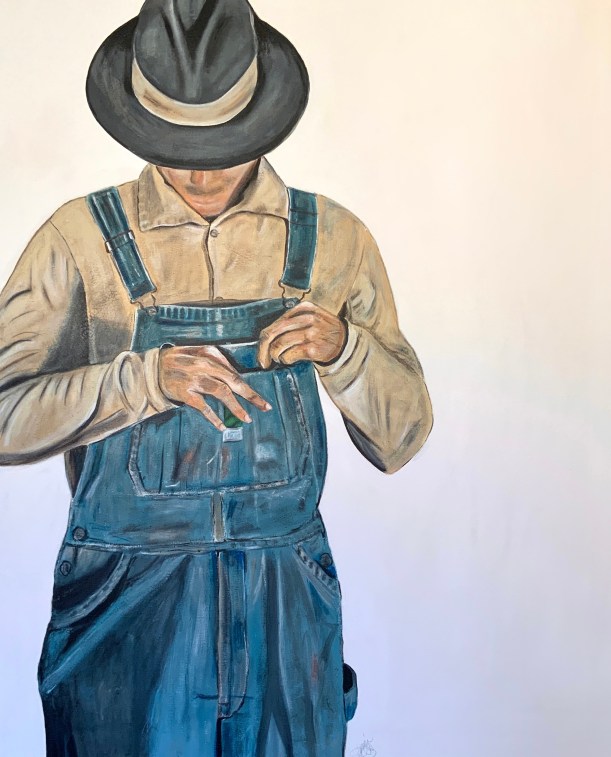
It was one of the greatest mysteries to me, the perfection of the rows in the fields. I knew nothing about farming, nor even driving, when I asked my grandpa how he did it. “I just see them,” he said. “But how do you not run over it all when you turn the corner? Or get out of line when you take a sip of coffee from the thermos between your feet?” “I know where I am, and I know where I need to be. It makes it very clear.” “That’s a lot to see,” I said, still not certain that I would be able to do it. “Will I be able to do it?” “This, probably not, but you’ll see what you need to see.” “How will I know?” He got on the tractor, and showed me.
I don’t know the exact moment it happened. How I found my row. My place. But I did. It all became so clear on the page and on the canvas. People ask me all the time — How do make them so real? How do you bring them to life? The truth is, I just see them. And it is my hope, that they see what I see, and others too… then they will know they are beautiful. That’s why I paint the portraits.
I can’t tell you how it happens. So I simply hop on my daily tractor, and write and paint, and I know, somehow, we’ll all find our way.
I have know idea how they got them in the house. It never occurred to me to think of those things — the logistics of moving an organ, a clock. And just as I assumed this clock that coo-cooed on the hour was called a Grandfather clock because it was his, I thought it was a Grandma organ, because it was hers.
But it must have been fairly spectacular – this finding of an organ mover, a clock mover, to a farm house just outside of Alexandria, Minnesota. And they must have come through the front door – a door we never used, never even considered. And even if they came through this front door, there would have been a stoop to be navigated. A tiny hall before reaching the living room. But as I said, I didn’t think of it, how they got there. But I did count on it, them being there.
And that was the gift, I suppose. It was all an assurance. One I didn’t ask for, or prayed to keep, I just had it. I knew, without a doubt, what would be found in this house. Coats and overalls hanging in the entry. A kitchen table with uneven legs. Candy in the corner cupboard on the lazy-susan. Sugared cereal beneath the silverware drawer beside the kitchen sink, a kitchen sink that was forever filled with dishes. Something on the stove. Publisher’s Clearing house magazines on the dining room table. The hint of pipe tobacco and baked goods. Television on. A ticking clock. The hum of the organ at the ready. And a love, no matter how many doors or windows were left open, would never leave.
So it continues to be spectacular — this never knowing how it all got in — mostly the love. I just remember always having it. I still have it. And what a thing to move! To carry throughout a lifetime! Enough to make a heart ever coo-coo and hum.
I suppose it all takes time. To see the ordinary. And to appreciate it. Those of you that follow me here, have come, I hope, to know my grandparents, my mother, my schoolmates, and teachers. Some might say “just plain folks.” And that’s probably true. But maybe that’s the real beauty of it all. To find the spectacular in farmers, housewives and receptionists. To see the extraordinary in the daily living.
And in seeing them, it helps me see myself. Helps me find the gratitude of the day given. Of the toast for breakfast. The smell of coffee. The hand that reaches out for mine.
I am reading the book, “Love, Kurt (The Vonnegut Love Letters). I have this book, only because I have a special friend. Last year, together with our husbands, we went to Stillwater, MN. My friend and I stood in the bookstore as if before the Christmas morning tree. So many gifts in front of us, we had a hard time deciding. We each settled on our present. I loved her choice as much as mine. This year, she gave her book to me. Those simple words don’t seem to give it enough meaning, but I will tell you that it fills my heart. It brings me back to a laughter filled day on brisk streets and slow choices. It, for me too, is a love letter.
In the book, Kurt Vonnegut writes with his young pen, to his young wife, “Angel, will you stick by me if it goes backwards and downwards? Holy smokes, Angel: what if I turn out to be just plain folks?” Tears fill my eyes. I imagine we’ve all had the worries. Will I be special enough to be loved?
It’s these memories, of course, that give me that comfort. That give me the yes. My heart is packed full of the love from these glorious and plain folks. And I have loved them. Love them still. And I am one. Proud to be living with these extraordinary people. It is plain to see, they, we, are more than enough to be loved.
I can’t say it was the most comfortable lap, my grandfather’s. If you wanted something soft, you went to my grandma. Her lap was pillowed with sugary treats, and as soft as the toasted marshmallows she loved to eat from Jerry’s Jack and Jill grocery store. You could easily get lost in her folds of love. So what was it that my grandfather had? First of all, I rarely saw him seated. He was skinny. The farm saw to that. He smelled of earth and pipe tobacco. And just where my head would reach, between his chest and shoulders, were the hooks and buttons of his overall straps. The real comfort came, I suppose, straight from the heart. To be let in, this was the magic. To be offered these rare moments of respite. Between the field and the plate wiped clean with a sheet of bread. To be given the time, when time was currency. This was pure love. Perhaps it’s not visible to the naked eye, but I know the button imprint remains on my cheek, and somewhere deep in my heart.
People often ask me, “Do you come from a long line of artists?” My first thought is the quote from Vincent Van Gogh — “There is nothing more artistic than to love people.” My grandmother’s quilts still keep me warm across the sea. The portraits I painted of my grandfather keep me safe. Protected. My mother’s blouses wrap me in a love that will never die. I was loved. I am loved. Still. I walk daily within this gallery given. So, YES! The answer is always yes! I come from a long line of artists. Today, in my most humble of ways, on canvas and paper, I attempt to pass on the line. To pass on the love.
It would be hard to see at first glance, I suppose, but the chairs I recovered when first moving to France, remind me of my grandfather.
He didn’t say a lot. My grandma was the talker. So to know him, you had to watch him. It was his actions that told the story. And the truth that I saw was that he could fix anything. His tools were simple. Most, it appeared to me, could fit into a small handled, rusted box that he could carry in one hand from the shed to the field, where the tractor waited patiently.
This was business. He took it seriously. But one time he let me walk with him. Two steps to his one, I bit my lips to mute the million questions in my head. Just watch, my brain kept telling my curious heart. The music of the tools rattling seemed to lead the dance. With great precision he flipped and turned. Jolted and eased. Mumbled under breath. And the tractor started again. I sat on his overalled lap and he drove me back to the house. I told him I would return the toolbox to the shed. It wasn’t just to be helpful, I actually wanted to feel the weight of magic. It was surprisingly easy to carry.
When I first moved to France, I needed to find a way to fix the time. The real “difference,” was not just seven hours ahead, but how it could be filled. I didn’t understand the television. My phone didn’t work. Stores were often closed. People spoke in an unfamiliar rhythm. I had my painting. My writing. But there was still time to fill. I went to my heart’s shed and grabbed my toolbox. I decided to recover two chairs. I had never done it before. Never even knew that I wanted to, but here they were, these two chair frames, so I began to work. With Dominique’s help, I found the fabric, the stuffing, the upholstery nails, the sandpaper, the paint. And began. The sanding and the painting went well. The stretching of fabric over the cushions took some trial and error, but I figured it out. Then the nailing — the endless nailing — hour after hour of nailing. But I did it! I did it, I said again to the heavens. And as I placed one in the entry and one in our library, I could hear the engine roll over, feel the puff of smoke, and the tractor wheels turn. It was magic.
Without saying it, he taught me to find a way. Each day has its challenges, but I’m carrying a box of magic.
It’s no secret that I read a lot. Often they make the books into movies. Often I’m disappointed. For me, the words seem to paint a more realistic picture. A vivid representation of the person or people inside the story. Not tainted or swayed by the pressures of Hollywood. I wonder when we were first sold the idea that people, in order to be a hero, or heroine, had to “look the part.” I, I say with great fortune, have lived a life to the contrary.
I have written about so many that have saved me through the years. Mr. Whitman, the caretaker of the cemetery, dirtied and slumped from the weight of burying the people from town. My grandfather, callused hand reaching behind his stained overalls to bring me along, bring me through. Chubbied Grandmother wiping kitchen hands on apron, just to give us something sweet. Wearied teachers, still finding a way to say the words that just might carry us. Tear-stained mother who laughed with unfaltering grace.
So it came as a surprise to me, the woman in New York standing in front of my portrait of Maya Angelou — a sage I return to again and again. She read the words and seemed to be moved. She praised them. I thanked her. She wanted to buy copies, but whispering sheepishly now, “maybe without the picture.” Whispering even lower now, “you know, maybe she could be a bit polarizing to my customers.”
I laughed. How ironically and completely opposite of the words that she claimed to love.
Kindness. Truth. Beauty. Wisdom. Hope. Leadership. Strength. Love. It comes in all sorts of “packaging.” Each a gift.
Maya would have forgiven her. As she always said, “When we know better, we do better.” I put the words and paintings before you, before myself, daily, in the hopes of doing just that… better.
I don’t know who it belonged to. It certainly wasn’t my grandma — even though we found it, my cousins and I, in her upstairs closet. Digging beneath the sombrero, the military uniform and the extra bedding, we jumped back, toppling over each other on the hardwood floor. Was it alive? It had eyes! Fur! What was it??? With a pool cue from the corner of the closet, we moved it into view. A dead fox. Long straight, headed and tailed. Did it crawl in from the field for a siesta (under the sombrero on this Minnesota farm)? And then died? We kicked it down the stairs beside my grandma standing in front of the kitchen sink. (She was always in front of the sink, yet the dishes were never done — but that’s another story.)
“It’s just a stole,” she said, “a fox stole.” Not understanding the word, we assumed the dead fox was now some sort of robber. “No, to wear around your neck,” she said. The explanations kept getting worse. It was unimaginable. We threw it at each other. Maybe she said who it belonged to, but I don’t think so. We soon grew tired of it. We would have left it on the kitchen floor, but she told us to put it back, never asking why she wanted to keep it. We loved her. So we did.
The only accessory we knew Grandma Elsie to wear was an apron. And that was enough for us. She donned what some called sensible shoes and house dresses, which made it easy, I suppose, for us to forget that she was not just a grandma, but a woman of this world.
Pardon the reference, but it’s hard to see “everything, everywhere, all at once.” We get bits of people, glimpses really. We grab onto the parts that serve us best, and a lot remains, well, in the closet. This is not to say we need to know everything about everyone. But I think it’s good to realize that we don’t know everything. People have riches and reasons that we will never realize. And instead of being afraid of that, we should respect it, celebrate it even.
I don’t know if my grandma was ever in Mexico. But in my head she was. Possibly even wearing a fox stole. Or maybe it was just Great Aunt Ellen’s. Maybe she bought it at Tvrdik’s garage sale, just up the road. It doesn’t really matter. What I love is that there was a world to discover in her home. A home where we were allowed to run free. To become exactly who we wanted to be. This beautiful farmhouse, with security and surprise, that grew so much, grew so many.
I asked him if he wanted to draw with me. He was still in his overalls, tired, needing to wash up before dinner. I open my Big Chief notebook wide. Folded the crease of the binding so it lay flat and spread before the two of us on the card table my grandma had set up for me. “I don’t know how to draw,” he said. “Yes, you do,” I said. “I couldn’t even draw a straight line,” he said. “But I don’t need a straight line,” I said, holding up my ruler. He laughed and picked up one of my crayons. I knew he was tired from a day of farming under the sun. I just needed to know he wasn’t too tired. For me. He wasn’t. Soon I told him it was ok, that he didn’t have to draw anymore. I would finish the picture. He smiled and went to wash for dinner.
I drew a picture of him on his tractor. I had watched him earlier in the day. Moving with precision up and down the seeded field. The rows were perfect. Straight. Beautiful. I replicated them with my ruler.
When he returned to the table I handed him the picture. “It’s you,” I said proudly. He smiled. “See,” I said, “you CAN draw a straight line, only you use a tractor.” He gently held the proof in his hand.
There is always a way to connect. A way to find a place at the table.
“When the barn catches fire, I am wearing the wrong negligee…” Maxine Kumin (from her poem The Longing to be saved.)
My mother’s first fire was not on the farm where she was growing up, but the dorm of her school. She didn’t want to go away to this school, but her parents were sending her older brother Ron because it was an Ag School (meaning it finished the courses early in the year so the students could go back to work on their family farms.) It was less than an hour away by car, but with no phones, no form of communication whatsoever, the distance felt unbearable.
Of course the fire started at the beginning of the week, not long after she was dropped off. There would be no contact with her parents until the end of the week when they came to pick her up. Forced to run from the burning dormitory, to save herself, she had to leave everything behind. She stood outside in her pajamas as the flames lit the northern sky. The neighboring dorm was saved. She was able to borrow clothes during the week from another reluctant farm girl. Returning them to her lender Friday afternoon, she stood at the school’s entrance in her pajamas, waiting for her mother.
Not many words were exchanged in that long car ride home. But she was allowed to go back to her high school in town the next year.
It wasn’t her last fire. Literally or figuratively. Through the years she would be asked to run from life’s flames and save herself. To save me. And she did it, never out of fashion.
She loved poetry. She would have loved this poem. I wish I could have found it sooner. We would have read it together. Word by word. Over and over. Laughing. Crying. Saving each other. Again and again.
I miss her. So much. Some days the embers feel too close as I stand “barefoot and pajamaed.” But then a sweet memory appears, of joy, of laughter, of love, and I feel her car pull up into heart’s view. And I am saved.
If you’ve been a follower, it probably won’t alarm you to hear that we moved Uncle Wally into the back yard. (Uncle Wally is our baby Walnut tree who is not such a baby any more.) It’s not surprising how easily and quickly he outgrew his space by the front door. But we were more than a little amazed at the strength and depth of his roots.
On hands and knees we dug for three days. The impressive tangles crept deeper and deeper. Impossible to just pull. So this is how he did it. Does it. Stands against the Mistral (the winds of provence).
There are times in life when we are asked to do the same. Forced to dig to the very depths of our soul and hang on. And it’s hard and it’s messy, but when you find it, when you get to the roots of your very heart and soul, and see how strong they really are…it’s then you stand a little taller. A little stronger. It’s then you have the strength to not only withstand the wind, but provide a stable force for someone else. Someone still fresh in the dig.
We can do this for ourselves. For each other. I think we’re meant to. Grab hold. Dig deep. It’s nature at its finest.