Jodi Hills

So this is who I am – a writer that paints, a painter that writes…


Leave a comment

To keep our pink ladies dancing.

I used to imagine that the front stoop of my grandma’s house was only there for the family of Hollyhock dolls that grew on either side of the cement steps. I was only allowed to pick a few each season. She showed me how to pluck the flower from the stem, flip it upside down and push an unopened bud through the then top to make a head that rested above the pink flowing dress. And for the rest of the afternoon, this small gathering of elegant ladies danced outside the entrance reserved just for them.

I gave them the voices to compliment each other. “How lovely is your pink dress!” “And yours is beautiful!” I danced them together like my mother once did at the Lakeside Ballroom with her cousin Janet. And the music from the transistor radio scratched in and out as I adjusted the antenna in the summer breeze. The lessons of last summer were forgotten. I had no fear of the wilting dresses. I only played. And played, believing that all beauty on Rueben and Elsie’s farm would ever remain.

I wasn’t wrong. Yes, the flowered dresses lay almost flat by the end of the day, but decades and countries away, the beauty remains. Yesterday, in the French countryside, she showed me the one Hollyhock flower that somehow grew between the century old crack of the house entrance. I wasn’t surprised. I had enough French words to tell her of how I made the pink ladies on my grandma’s stoop. We both smiled and touched the rhythm of her little pink dress.

I wrote in a poem, “This year… let’s love like no lessons have already been learned…” Of course we have to grow and educate and evolve. But some “lessons,” like those that deal with lost love, disappointment, unreached expectations — to keep our pink ladies dancing, we have to let those go. The heart stoops must remain clear and ever hopeful.

Countless things grew on Rueben and Elsie’s farm. Again and again. And the beauty will ever remain. I wake to this morning sun, and keep on dreaming.


Leave a comment

A Schwan’s delivery.

It was hard to believe that something so delicious could make me ill. But it was evident after only a few tries, I couldn’t eat ice cream. Somehow still, I found it very exciting when the pale yellow blur of the Schwan’s ice cream delivery truck drove toward my grandma’s house. I began running up the gravel, hands waving in air, directing him into the driveway. I knew full well that my grandma’s love of root beer floats would never allow her to miss a delivery. I hopped and skipped and ran with the truck to the house. Uniformed and certain, he jumped the steps and went to the back of the truck. “You’re Elsie’s granddaughter?” “Oh, yes!” I said proudly. I could tell by the smiling way he said her name that he liked her. He unloaded two of the giant tubs as my grandma came out the screen door. Her hands ever floured or wet, or both, she wiped them on her apron before signing for our haul of vanilla. 

How wonderful, I thought, to deliver ice cream. Everyone must be so happy to see you. I was, and I didn’t even eat it. The only other delivery person that I knew was my Uncle Mike, who drove a beer truck in the Twin Cities. I asked him if people jumped up and down when he arrived. He looked confused. Like I do with the Schwan’s truck, I explained. Not so much, he said. Maybe you should paint your truck yellow, I said. He smiled. 

Surely it has to be taught. There must have been a million things my grandma delighted over with me. Things she had no interest in. How else would I have known, known this joy of feeling good for others. I loved art and clothes and drawing and crayons and “Look, look what I made! It’s flowers glued to a scrap of bark! Look!” And my grandma showed all of her teeth in love. An ear to ear joy. This is the only explanation I have for being happy, truly happy, to celebrate a Schwan’s delivery, not for me, but for her!

Joy is not owned. It is passed and given away freely. It is run along beside. A yellow blur of others. The day is pulling toward the driveway. I raise my hands in the air and skip to whatever joy it may bring. 


2 Comments

Reattaching apples.

I have no memory of the apples growing. Each year, they were just there. The branches seemed to go from bare to weighed in just the blink of an eye. And as quickly as the green apples appeared in my grandparents’ trees, we were tripping over them in the grass, loading sack after brown paper sack to give away. 

Maybe it’s the way of all living. It goes so quickly. We move from grand point to grand point, missing all the little things along the way. The how we got heres. The growths. 

I keep trying to think of her as a young woman — the journey of how Elsie became Grandma Elsie. She wasn’t always in that kitchen. In that yard with an upturned apron full of apples. She once had to have giggled with the girls behind the school. Cursed her parents and dreamed of boys. Imagined a life. A future. 

To know the exact details, I suppose, would be like trying to reattach the apples to the tree. But I think it’s enough to know there was more. There is more. So much more to all of us. There are reasons and seasons of how we got here. And maybe we’ll never know all of it, but I think there is empathy in the attempt. Compassion in trying to imagine the whole picture. None of us are just one thing. Maybe in learning that, we come to see some growth after all.


Leave a comment


When someone shows you their hope, it’s hard to unsee it.


Living in the south of France, I see the Sainte Victoire mountain daily. Each time, I give thanks for my current view, and also for the view Paul Cezanne gave us in his paintings. Would I have seen it without him? Would I have noticed the extraordinary beauty of this mountain without his vision? I’m not sure, so I give thanks with each passing step.

I suppose it has always been this way. My grandfather did the same with his farm. Without him, perhaps these fields would have just been blurs from a car window. But not for me. Not since walking with him. Holding his roughened artist hand that turned those fields from black to green to gold each year. Work. Magic. Love. I slow down the car.

We all have a responsibility to find the beauty. To share it. It’s everywhere. Poets and philosophers have tried to explain it. (Certainly smarter than me.) But maybe it’s all about hope. Maybe that’s what makes everything beautiful. So that’s what I try to create. In the faces. In the paintings. In this life. There is hope. Always, if we choose to see it, and share it with each other.


1 Comment

In the white space.


One of the best lessons I learned as an artist was not in the creation, but in the white space. Whether it is on the canvas, or the wall around it, there has to be space for the eye to rest. The white space. To see the art, to really be able to feel it, there must be space around it, so it can breathe, it can live. When it all becomes too cluttered, then nothing can really be seen. Not even the best of art.

I suppose it’s the same with living.

There are a million books written about it. Grief. It only recently occurred to me — looking at my grandfather’s portrait. I’m living in that white space. Missing my mother. (My grandpa and grandma too.) But it made me feel better, seeing it this way. It’s all part of the big picture. This white space — this emptiness — it shows us the real beauty of life. And it’s not separate from the art of living, it’s a necessity. So I feel it. And I know that I’m lucky. What a privilege to be a part of these glorious lives. To rest in the space beside them. Knowing that we are all a part of the same work. We are together. Always.

I only mention it because maybe you are missing someone. Maybe you are resting in this space. And maybe, for a moment, you too can see the beauty of it all — the endless art of this living…


Leave a comment

Plain to see.


I suppose it all takes time. To see the ordinary. And to appreciate it. Those of you that follow me here, have come, I hope, to know my grandparents, my mother, my schoolmates, and teachers. Some might say “just plain folks.” And that’s probably true. But maybe that’s the real beauty of it all. To find the spectacular in farmers, housewives and receptionists. To see the extraordinary in the daily living.

And in seeing them, it helps me see myself. Helps me find the gratitude of the day given. Of the toast for breakfast. The smell of coffee. The hand that reaches out for mine.

I am reading the book, “Love, Kurt (The Vonnegut Love Letters). I have this book, only because I have a special friend. Last year, together with our husbands, we went to Stillwater, MN. My friend and I stood in the bookstore as if before the Christmas morning tree. So many gifts in front of us, we had a hard time deciding. We each settled on our present. I loved her choice as much as mine. This year, she gave her book to me. Those simple words don’t seem to give it enough meaning, but I will tell you that it fills my heart. It brings me back to a laughter filled day on brisk streets and slow choices. It, for me too, is a love letter.

In the book, Kurt Vonnegut writes with his young pen, to his young wife, “Angel, will you stick by me if it goes backwards and downwards? Holy smokes, Angel: what if I turn out to be just plain folks?” Tears fill my eyes. I imagine we’ve all had the worries. Will I be special enough to be loved?

It’s these memories, of course, that give me that comfort. That give me the yes. My heart is packed full of the love from these glorious and plain folks. And I have loved them. Love them still. And I am one. Proud to be living with these extraordinary people. It is plain to see, they, we, are more than enough to be loved.


2 Comments

Doing Better.

It’s no secret that I read a lot. Often they make the books into movies. Often I’m disappointed. For me, the words seem to paint a more realistic picture. A vivid representation of the person or people inside the story. Not tainted or swayed by the pressures of Hollywood. I wonder when we were first sold the idea that people, in order to be a hero, or heroine, had to “look the part.” I, I say with great fortune, have lived a life to the contrary. 

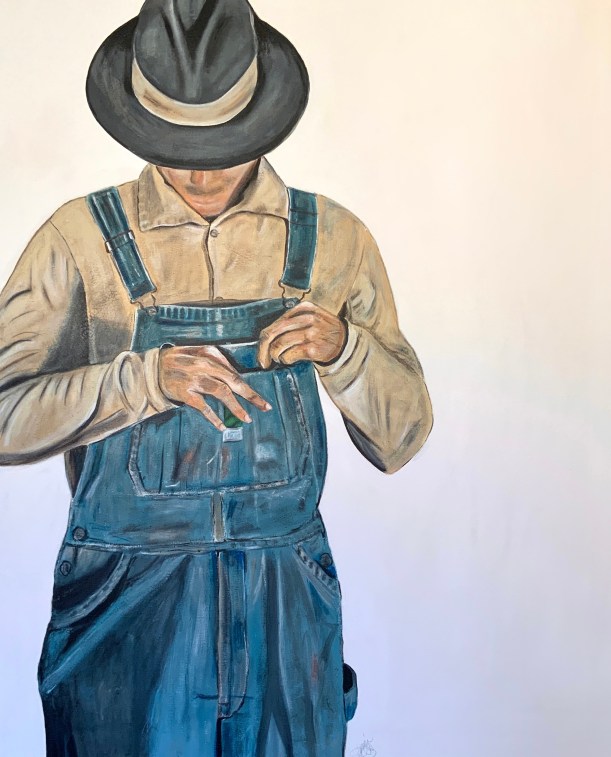
I have written about so many that have saved me through the years. Mr. Whitman, the caretaker of the cemetery, dirtied and slumped from the weight of burying the people from town. My grandfather, callused hand reaching behind his stained overalls to bring me along, bring me through. Chubbied Grandmother wiping kitchen hands on apron, just to give us something sweet. Wearied teachers, still finding a way to say the words that just might carry us. Tear-stained mother who laughed with unfaltering grace. 

So it came as a surprise to me, the woman in New York standing in front of my portrait of Maya Angelou — a sage I return to again and again. She read the words and seemed to be moved. She praised them. I thanked her. She wanted to buy copies, but whispering sheepishly now, “maybe without the picture.” Whispering even lower now, “you know, maybe she could be a bit polarizing to my customers.” 

I laughed. How ironically and completely opposite of the words that she claimed to love. 

Kindness. Truth. Beauty. Wisdom. Hope. Leadership. Strength. Love. It comes in all sorts of “packaging.” Each a gift. 

Maya would have forgiven her. As she always said, “When we know better, we do better.” I put the words and paintings before you, before myself, daily, in the hopes of doing just that… better.


Leave a comment

Security and Surprise

I don’t know who it belonged to. It certainly wasn’t my grandma — even though we found it, my cousins and I, in her upstairs closet. Digging beneath the sombrero, the military uniform and the extra bedding, we jumped back, toppling over each other on the hardwood floor. Was it alive? It had eyes! Fur! What was it??? With a pool cue from the corner of the closet, we moved it into view. A dead fox. Long straight, headed and tailed. Did it crawl in from the field for a siesta (under the sombrero on this Minnesota farm)? And then died? We kicked it down the stairs beside my grandma standing in front of the kitchen sink. (She was always in front of the sink, yet the dishes were never done — but that’s another story.) 

“It’s just a stole,” she said, “a fox stole.” Not understanding the word, we assumed the dead fox was now some sort of robber. “No, to wear around your neck,” she said. The explanations kept getting worse. It was unimaginable. We threw it at each other. Maybe she said who it belonged to, but I don’t think so. We soon grew tired of it. We would have left it on the kitchen floor, but she told us to put it back, never asking why she wanted to keep it. We loved her. So we did. 

The only accessory we knew Grandma Elsie to wear was an apron. And that was enough for us. She donned what some called sensible shoes and house dresses, which made it easy, I suppose, for us to forget that she was not just a grandma, but a woman of this world. 

Pardon the reference, but it’s hard to see “everything, everywhere, all at once.” We get bits of people, glimpses really. We grab onto the parts that serve us best, and a lot remains, well, in the closet. This is not to say we need to know everything about everyone. But I think it’s good to realize that we don’t know everything. People have riches and reasons that we will never realize. And instead of being afraid of that, we should respect it, celebrate it even. 

I don’t know if my grandma was ever in Mexico. But in my head she was. Possibly even wearing a fox stole. Or maybe it was just Great Aunt Ellen’s. Maybe she bought it at Tvrdik’s garage sale, just up the road. It doesn’t really matter. What I love is that there was a world to discover in her home. A home where we were allowed to run free. To become exactly who we wanted to be. This beautiful farmhouse, with security and surprise, that grew so much, grew so many.


2 Comments

A place at the table.

I asked him if he wanted to draw with me. He was still in his overalls, tired, needing to wash up before dinner. I open my Big Chief notebook wide. Folded the crease of the binding so it lay flat and spread before the two of us on the card table my grandma had set up for me. “I don’t know how to draw,” he said. “Yes, you do,” I said. “I couldn’t even draw a straight line,” he said. “But I don’t need a straight line,” I said, holding up my ruler. He laughed and picked up one of my crayons. I knew he was tired from a day of farming under the sun. I just needed to know he wasn’t too tired. For me. He wasn’t. Soon I told him it was ok, that he didn’t have to draw anymore. I would finish the picture. He smiled and went to wash for dinner.

I drew a picture of him on his tractor. I had watched him earlier in the day. Moving with precision up and down the seeded field. The rows were perfect. Straight. Beautiful. I replicated them with my ruler. 

When he returned to the table I handed him the picture. “It’s you,” I said proudly. He smiled. “See,” I said, “you CAN draw a straight line, only you use a tractor.” He gently held the proof in his hand. 

There is always a way to connect. A way to find a place at the table.


Leave a comment

Come-with gal.

She would go to almost anything. See almost anyone. One ring of the party-line telephone and she’d be getting in the car. With me hesitating on the steps of her farmhouse, she’d look back and say, “Be a come-with gal.” And even though it sounded like a horrible thing to do — this garage sale, this coffee in the church basement, this visitation at the funeral home– she would continue to smile at me, and the curl of her upper lip cartoon-pulled at my t-shirt, and soon I’d be getting in the car. 

“Oh, it’s gonna be great,” she said, talking over the farm report on the radio. I loved her and I wanted to be convinced. Only Paul Harvey could stop the sell. We rolled up the windows and listened. 

Each event itself would have been, well, uneventful, but it was the time with my grandma that made it so special. Everyone knew her. From the moment she entered a room, or a lawn, the words, “Oh, Elsie…” rang through the crowd. All I could do was watch the show. I marveled at the fun she was having. More than anyone else it seemed. I guess it was because she had already decided while opening the car door, that she was going to have a good time. All worries and expectations flew out the window. Her extra wide house shoes turned into ruby slippers and she was determined to have some fun. 

It’s easy to forget. The mundane tasks of grocery and hardware can seem like a drudgery at times. Dominique will ask if I want to go to Leroy Merlin (our version of Home Depot) and it feels like it would be so easy to turn away. But then I see her. Hear her smiling. “I’m a come-with gal,” I say, and get in the car.

If she missed a day, I didn’t see it. I think she heard the voice that called daily, to come along for the ride. I wake up to the morning, smile, and listen.