Jodi Hills

So this is who I am – a writer that paints, a painter that writes…


Leave a comment

What’s taught is what’s known.

Miss McCarty said the composition must be typed. This was in my tenth grade year. A year when typewriters still existed. A year before I would take typing class. A year when senior girls would type your paper for ten dollars. A year when ten dollars coming out of my mother’s paycheck (a paycheck from the very school that requested the typed composition) could rock our monthly budget enough that something else had to be denied. A year when I couldn’t bear to be that rocking cause. 

Miss McCarty was, for the most part, terrifying. I sat in the front row because I thought it would be easier “to see it coming.” Oh, there were some teenage boys that tested her, but only once. I always finished my homework. Early. And I my handwriting was neat. It was my last class of the day. The final bell rang. I sat in my seat. I had two copies of my composition, not yet due for several days. One in cursive. One printed. “You can read it easily,” I tried to explain. “No,” she said. I could feel it welling, this one tear. I willed it not to escape. It rested on my eyelash. She tidied her desk. Stood up. Starting walking to the door. I stayed seated. “I don’t have it,” I quivered. “What?” she asked. “The ten dollars. I don’t have it.” She took the papers from me. Put them on her desk. “It has to be typed,” she said and walked me out the door. The tear let go and I walked across Jefferson Street.  

I don’t know if she paid for it. If she typed it herself. But when I returned to class the next day, it was sitting on my chair. Typed. I looked up at her. She wasn’t smiling, but she gave me a nod. And it was done. 

I turned it back in with the other students. I knew she didn’t want a gushing thank you. That wasn’t her style. 

She returned the graded papers. I received an A, and a note at the bottom — “You can always find a way.” I caught her eye and nodded. 

I’m typing with my left hand and two on my right. Ever healing. Ever grateful. Finding my way. 


Leave a comment

Gentled in.

Perhaps it was because she was “giving us the keys to it,” but when Mrs. Bergstrom wrote the word ‘cast’ on the chalk board and called out to my hand that shot in the air, I yelled proudly, “Castle!” Her hair was pulled back so tightly, her smile was almost permanent, but this was more than that, almost gentle was her grin, “No,” she said softly, “but almost, and it’s a great word.” She let me come to the board and write out my word. Showed me the difference. It was an error in spelling, yes, but it never felt like a mistake. It felt like learning. I suppose that’s the greatest gift she gave to me.

Some of my paintings sell very quickly. Others don’t. They are all my castles. Each has taught me something. All have led me to my current palette. The place that fills my soul, comforts my heart and stretches my creativity. The place I live. It’s a process. I’m not always this gentle with myself. I can be short. Discouraged. Impatient. But I’m learning. And when I remember this, I see her face, smiling beside me, and I feel gentled into the lesson at hand. Some last a lifetime.

What’s taught is what’s known.


Leave a comment

The romance of the keys.

We learned to type on electric typewriters at Jefferson Senior High. You could hear the click of the keys from down the hall. It was located on the other side of the school building from the band and choir rooms, but there was a music to it, all the same. 

I certainly don’t miss the “white out,” or replacing the ribbon. But there was an art to it. Even when we were all typing the same thing — “The quick brown fox jumps over the lazy dog.” — we would make our own mistakes, different letters would be painted over, then typed over again and each sheet was an original, with it’s own look, it’s own sound. 

I type now on my iPad. It can go with me anywhere. I can correct mistakes in an instant. There is an ease, a freedom, unmatched. But I must admit, there is a tiny part of me that longs for the music. The romance of the keys.

I want to allow for this in my daily life. I want to see the romance in all of my mistakes — and oh, I am making them for sure — daily tangled in my not so quick brown foxes. I, we, need to see the beauty of the learning. 

Today’s blank sheet opens with the sun. I set off, not in search of perfection, but poetry. Click, click, click, begins my imperfect heart. 


Leave a comment

Heading North.

Heart first.

I know there are strategies to Wordle. Of course certain letters appear more than others. Using the most vowels on the first word is helpful. If you want to take a deep dive, there are websites. Tips. Tricks. Hacks. I love the game, but I don’t play like that.

Yesterday, the first email I received was inquiring about my painting of the North End. I used the word “north” as my second word, and solved the puzzle. It’s fun to get a two, sure, but for me it’s the most fun when I can relate it to what’s happening in my life. Not that I think the New York Times actually bases the game around me. It’s not “about” me — I know this. But I like to be involved. Insert myself in the game. I want to be a part of it all.

All the teachers at Washington Elementary gave us valuable skills. How to read, spell, write, do the math. But it was Miss Green who not only gave us the tools, but showed us how to build something. We could have just written reports. Structured sentences and paragraphs, but she had us taking Spelling Trips. Each week we randomly picked a place on the map and had to write a story about getting there, being there. We had to place ourselves inside the lesson.

I suppose I’m still doing that. Joyfully. What’s the point of learning, of living even, if I’m not involved. Certainly it changes the stakes. I know being involved means I’m also going to risk being hurt. Hearts on sleeves are vulnerable — but oh how they can feel the love!

You can play it however you like — Wordle, this life… that’s the beauty of it, we get to choose. Me, I’m going to throw myself in the mix, heart first — heading North!


Leave a comment

Open road.

It was just after recess. Even on the coldest of days, we were always sweaty. We hung our coats back on the pegs. Mrs. Erickson stood at the front of our third grade class. She had a stack of papers in her hand. She told us to sit and take out our No.2 pencils. She gave a handful to the front person of each desk row. We passed the sheets back to the person behind us, along with our comments and guesses of what was to come. Each pass was like a short game of “whisper around the world.”

I held the horizontal lined paper between my fingers. It seemed all good things started with paper at Washington Elementary. The paper was lined, but not just single lines. Groups of three. Two solids middled by a dotted line. I was certain they were little highways. I would turn out to be right.

She used a three pronged chalk to make the same lines on the blackboard and began our cursive journey. She had the most beautiful penmanship I had ever seen. Upper and lower cases flowed along the paper highway, and we were off! We had already learned to read. Mrs. Bergstrom saw to that. But this, she said, was how we would communicate. It would be part of our identity. I opened the windows of my imaginary car. The wind blew through my hair and hand and I began to write. My name. My address. Sentences. Tiny trips at first, and then I was out on the open road. Faster. Longer. Free!

In the tenth grade, they taught us “behind the wheel,” in Driver’s Ed. But it was Mrs. Erickson who first gave us the keys.


Leave a comment

A stroke of Mrs. Bergstrom.

There is a reason we call it spelling. The magic of the letters, when put together to form words, can indeed cast a magical spell within and around us. 

She stood in front of the class of first graders. Mrs. Bergstrom. Tall and straight. Not with a robe, nor a hat, but she did have a wand. Some might remember it as just a teaching pointer. But not me. As she tapped it against each letter chalked perfectly on the blackboard, white dust — fairy dust I was sure — sprung into the air. We were spelling. And it was magic. 

That magic moved from the blackboard to our Big Chief notebooks. Then marched with us single file to the library down the terrazzo halls of Washington Elementary. With each book we moved into neighborhoods. Made friends with dogs. Rode horses with cowboys and bloomed into teenage girls, and boys with paper routes. Everything was possible in the words. 

I’d like to think it still is. As I type each morning, I take that magical journey. With each letter I make a path. Sprinkling it with a stroke of Mrs. Bergstrom. Because it’s all beautiful, even the hardest of days — when wanded into the words of “look what we survived,” and “look what we’ve become” — are nothing short of magical! I still believe it. I have to believe it. I hope we all can.

Because she didn’t just give us the happy words. She taught us how to spell. How to make our way through it all. Today, I too will stand straight and tall. And I promise, I will not waste the magic.


Leave a comment

The teachers.

It’s not lost on me that the math problem Mr. Lee was trying to explain on the overhead projector, was indeed, over my head. I suppose it was this focus on words and other such artistic attractions on my three ring binder that kept me from understanding the equation. We were all told to secretly write down the answer and walk it up to him. One by one I saw my classmates make the trip. Some racing with delight. Others tripping back to their desks in defeat. My hair, still wet from swimming class the period before, dripped on my blank paper. The bell rang and with a giant sigh of relief we all got up to head toward the door. No, he said, raising his one arm. Even with one sleeve folded and pinned to his shirt in that arm’s absence, he was the most intimidating teacher we had at Central Junior High School. He said we couldn’t leave without the answer. The few that had gotten it, laughed and raced into the filling hallway. Had I spent less time calculating my route to Mr. Temple’s Social Studies class, and more time on the problem, perhaps I would have gotten the answer. Mr. Lee made a few marks on the plastic with his red pen. This apparently was enough to get a few more students out the door, but the rest of us remained. He winced at the phantom pain of his empty sleeve. We did the same for our answerless sheets of paper.

He shut the projector off. Looked at me. Directly at me. I smiled — not because I was acting “smart.” (That ship had sailed.) No, I smiled to tell him it was ok. We’d do better tomorrow. I smiled because we were neighbors after all. He couldn’t keep us here forever. People knew my schedule. I rode the bus with his children. My mom had Saturday coffee with his wife Yvonne. He wrote the answer down on the hall passes that he gave us to get to our next class.

The answers weren’t always clear. But we were always learning. You couldn’t help it. The examples were everywhere. In every room. The courage, patience, and strength displayed each day from those who stood in front of us. Willing us to a better understanding.

Later that evening. When my hair was dry. And my thoughts were clear. I looked at the problem again. It made sense. “Showing my work,” I penciled my way to the answer that he had given. After dinner, I walked the gravel of Van Dyke road to his house. I could see the lights on in their dining room. Lincoln, Tracy and Tony were still eating. I printed my name in the upper right hand corner of the paper and placed it on their front porch.

My mother was standing in the well lit doorway as I walked up the drive. She smiled. There was so much to learn.


Leave a comment

Newsprint and Windex.

.

It was only an hour each weekday. After school. I’d get off the bus at around 3:30pm and wait. Two picture windows faced our driveway. Some days, I could be distracted by The Brady Bunch, but the majority of those 60 minutes before my mom came home from work was spent waiting against those windows.

They taught us at Washington Elementary not to touch the glass windows that lined our classroom, because it was the janitor who would have to clean the windows dailly. And we didn’t want to make his job harder, did we? But seeing how it was my job to clean the windows at home each Thursday afternoon with newspaper and Windex, I wasn’t that concerned. I fogged the glass with my breath. Drew smiley faces. Smeared them away. Blew again. Then sad faces. Erased and blew. Challenged myself to tic-tac-toe. Continuously smearing cheek and fingers across the glass. Waiting. And waiting.

The gravel road always gave sufficient warning. The sound of the tires popping at 4:37pm would tell me that my mom was about to arrive. I’d hoist my top above my waist and wipe the window. Race to the garage entry. Fling the door. And I was saved.

She never mentioned it — the streaked glass. But of course she must have known. It wasn’t like my t-shirt wipe gave a proper cleaning. But that’s who she was — the person who allowed me to be me. Never made fun of my silly antics. She saw me. And loved me.

I smiled each Thursday afternoon as I took last week’s Echo and wiped it across the pane. It sparkled clean along with my heart. A fresh start. All waiting’s worries were washed away.

I see it now. So clearly. I thought she was saving me, daily, and she did, but even more importantly, she gave me the ability to save myself. A gift I continue to use. I smile out my morning window, and I am saved.


Leave a comment

Posture.

It just occurred to me this morning who she looks like — the woman I painted on my bookmark. Mrs. Paulson. My fourth grade teacher at Washington Elementary. Never during that entire school year did I see her undone. Hair coiffed. Dress pressed so impeccably that I waited, watching for a wrinkle to appear. She wiped the chalk from her hands on a cloth that sat on the corner of her wooden desk. Not one to plop, she lowered herself slowly into her wooden chair. Her fitted dress followed. Not fighting, as if it knew the routine, and I guess it did. When she rose again from that wooden chair (too elegant to just “get up”), she smoothed her chalk-free hands firmly down the skirt of her dress, and it responded perfectly. Wrinkles never dared the hands of Mrs. Paulson. She stood tall. We listened.

Of course she taught us subjects and predicates. But she constructed more than sentences. For those of us paying attention, and I have to believe that most of us were, (as so elegantly commanded), we received lessons that far exceeded the normal classroom. Some might say, “Well, anyone could do that,” and that may be true, but not everyone did, nor does.

In the fourth grade I began to think about things like posture and elegance. Mrs. Paulson saw to that. Shoulders high and back, I sit at my desk and try to pass it on daily. With the help of all those who came before, I have indeed found my place.


Leave a comment

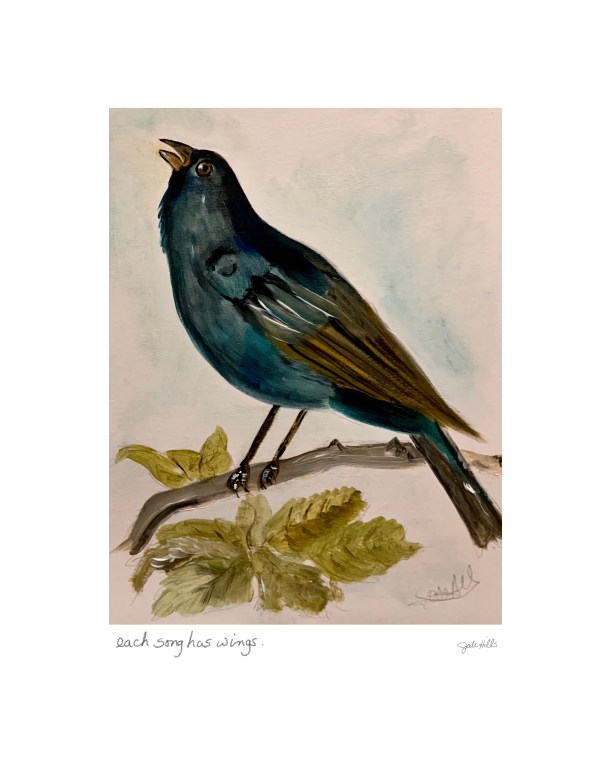
Each song has wings.

The worse we sang, the balder he got. Each wrong note hit in our seventh grade choir raised Mr. Dehlin’s hand to the top of his head, rubbing in desperation. How could he direct us to the right note? He seemed to be willing the answer inside his brain with the hand that carried the baton.

I don’t remember the note, nor the song, but no one in the alto section seemed to be hitting it. He directed David Alstead to hit the note on the piano. Again. And again. The note rang through the choir room. The problem was that that one poor note had to compete with all of the noise in our teenage heads. The noise of the upcoming exams in English and Math. Who was dating whom. Who was about to break up. Why was she wearing that? Would we be invited to the dance? Would there be time to get to get to the locker room to grab the forgotten book? Who would we sit next to on the bus. Again! — he pointed the baton at David. Again! He played the note and we sang something close to it as a section, but not close enough. Mr. Dehlin went down the line of altos, pointing the baton at each person. One by one. Note by note. Each missing by a hair – a hair that seemingly fell from his head to the floor. Twice through the line. Getting closer each time. He had our attention now. And we sang. We sang that glorious note. He raised both hands in the air, then collapsed them to his knees. We all cheered (in the right key!). It was only a note. But he got us there. There was still a whole song to learn. But he gave us our victory. Our moment. He stood tall again. Tapped the baton on the music stand. Gave a look to David. One quick flick of the baton, and we were off – in song!

Through our junior high years we held countless concerts. Parents gave us standing ovations for the mere fact of being born. But it was that impossible note reached that I remember the most. And what it took to get us there.

My love for music has never faltered. It has layed beside me during the darkest times. Danced with me through the highest. Pushed my lawn mowing legs. Moved my paintings, stroke by stroke. Brightened breakfasts. Made sacred each holiday, each friendship. Gave me the soundtrack for hellos and goodbyes. Note by note.

I suppose we never forget those who walk with us, battle with us, just to get us through — see us through — to become our best selves… those who give us not only the note, but also a reason to sing!