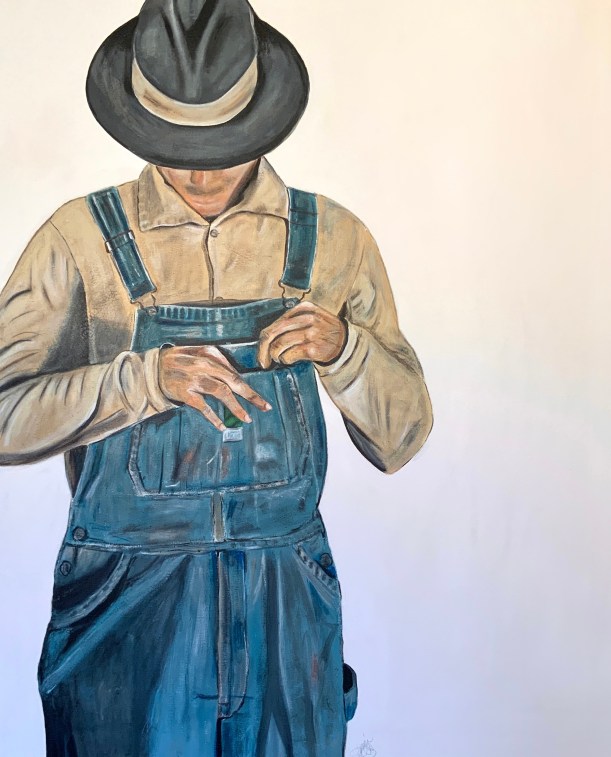
It’s ironic, I suppose, that we only played freeze-tag during our Minnesota summers. Lit only by the tenacity of the hanging summer sun, and the surrounding porch lights, we gathered in the vacant lot next to Dynda’s. It was usually Lynn or Shari Norton, being the oldest, who decided what game to play. I loved kickball. And softball. Even kick the can — though I’m not sure I ever understood the rules. The only game I didn’t love was freeze tag. If the person who was “it” touched you, you had to stop. Immobilized. Standing still. Alone. While others tripped in giggles and weeds, you had to just stand there. Excluded from the fun. Hoping that someone would come and touch you to free you.
It was just a game. I knew, standing there, I still had cool sheets to rest in. A kiss good-night waiting from my mother. But still. It became pretty clear to me, even then, that we need each other.
There are so many distractions in this world. It’s easy to lose sight of the lost. Those frozen in time and space. When maybe just a simple tag, a touch, a smile, could set them free. I’m as guilty as the next person. But I want to get better. And let’s be honest. It really doesn’t take all that much. A returned email. A letter. A phone call. A knock on the door beneath the porch light that waits. Maybe one day, we can all be tripping in the giggles and weeds.
It’s easy to think it’s beautiful at first glance. The perfection of the unused pastels. Pristine. Untouched. And I will admit I open the box slowly. Remove the padding. And let it sink in, all the possibilities. But for me, this is not the real beauty. No, things have to get messy to become beautiful. The pastels will lose their perfect shape as I stroke them against paper and canvas. The colors will cling to my fingers and get wiped on pants legs and on cheek bones as I bring the painting to life. I’ll be covered in the evidence of creation when I bring the finished product from the studio to the house. Viewing the colors still on my face, my husband will call me a warrior. And I proudly smile, because I am. I joyfully give my all.
I suppose it’s the same with love. With life. Some will never risk getting hurt. Never take a chance on anything. Never using the pastels of their heart. Not me. I want to get in deep. Covered in the evidence of experiencing it all. Even the shattered pastel has the ability to color. To create. To make something beautiful. Your heart is going to feel it, sure…but oh, the colors — the glorious colors of scattered love. It’s not to be missed.
I wake to this sun, labels peeled, middles cracked, rubbed uneven, and joyfully covered in love’s evidence. It looks like an imperfectly beautiful day.
I suppose everything is about context. It’s not like I’d normally be afraid of a pony. (I’ve even painted them.) But yesterday, when I looked up from the path to turn the corner and almost ran into one, I must say it was alarming. And he wasn’t alone. There was a donkey. A llama. Many sheep. Rams. Other ponies. I don’t know who was in charge of this gang by the river. There were no other humans in sight. Neither the sheep, nor the donkey seemed to care that I was there, but what I can only assume as the lead pony, looked at me like I was the suspicious one.
After taking pictures, I kept walking. The whole path seemed different. I felt disoriented. This path, that I could normally navigate in my sleep, suddenly felt completely strange. Had that always been there? What about this? Did I miss my turn?
I started to take inventory. I knew this rock. This tiny bridge. To walk up the slope on the left side. The smell of these trees. The purple flowers growing out of the concrete fence. I knew this path.
Life can throw you the strangest curves. And you can’t prepare for everything. And sometimes each step can become unfamiliar. When it happens, it may sound silly, but I always take my own inventory. Am I safe? Yes. Am I loved? Yes. Do I have to be afraid? No. I step aside from the wayward pony, smile, and keep walking.
Sometimes it takes me a while to get there, but I usually do.
I’m no different from the next person when it comes to packing a suitcase, if that next person is slightly neurotic and overly excited. It’s still three weeks away, but the neurons in charge of organization have already begun counting underwear and creating a capsule wardrobe. “Wouldn’t it be great,” they urged, “if we had packing cubes, and other various sorting devices for the suitcases…” I nodded inside my own head and began searching the web. The options, while infinite, didn’t seem exactly right. I searched through sizes and colors and prices. The right price was the wrong country of origin. The right color was the wrong size. The right size was the wrong price. I searched and fumbled. Added some to cart. Backed out. Searched again. After about an hour and forty-five minutes, it became clear that I could use the random tote bags given free from the pharmacy and the stash of bags my mother gave to me from the make-up counter promotions. I take a breath. I take a pause. I have everything I need. What a relief to quit searching…unless that is, I need more clothes… That’s when I play fashion show from my own closet and once again realize, I have more than plenty.
I suppose it’s true with almost everything — we don’t need more things, we need more ideas. Of course there are specific times when you require a precise tool, object, (even scarf or scarves to match your autumn overcoat), but most of the time I find, if I’m creative enough, thoughtful enough, I already have the perfect solution. And it usually feels great! To shop your own closet and create a new look. To sand and sand the abandoned wood and make a new frame. To create a delicious recipe out of the left-overs. To give the neurons a break and let my heart and hands take over.
Don’t get me wrong. I’m all for commerce. I bought two new books yesterday. (I will use the french bag as backing for a framed picture, but still.) And I want you to buy pictures and books and cards, even from me (insert shameless plug here). So what was my point? I don’t know…maybe Marie Kondo had it right, about all the “sparking joy.” I like that. I think it’s a good idea…I guess that was the point, after all, more ideas — more joyful ideas! Wishing you a day filled with them.
It’s no secret that I read a lot. Often they make the books into movies. Often I’m disappointed. For me, the words seem to paint a more realistic picture. A vivid representation of the person or people inside the story. Not tainted or swayed by the pressures of Hollywood. I wonder when we were first sold the idea that people, in order to be a hero, or heroine, had to “look the part.” I, I say with great fortune, have lived a life to the contrary.
I have written about so many that have saved me through the years. Mr. Whitman, the caretaker of the cemetery, dirtied and slumped from the weight of burying the people from town. My grandfather, callused hand reaching behind his stained overalls to bring me along, bring me through. Chubbied Grandmother wiping kitchen hands on apron, just to give us something sweet. Wearied teachers, still finding a way to say the words that just might carry us. Tear-stained mother who laughed with unfaltering grace.
So it came as a surprise to me, the woman in New York standing in front of my portrait of Maya Angelou — a sage I return to again and again. She read the words and seemed to be moved. She praised them. I thanked her. She wanted to buy copies, but whispering sheepishly now, “maybe without the picture.” Whispering even lower now, “you know, maybe she could be a bit polarizing to my customers.”
I laughed. How ironically and completely opposite of the words that she claimed to love.
Kindness. Truth. Beauty. Wisdom. Hope. Leadership. Strength. Love. It comes in all sorts of “packaging.” Each a gift.
Maya would have forgiven her. As she always said, “When we know better, we do better.” I put the words and paintings before you, before myself, daily, in the hopes of doing just that… better.
I don’t know who it belonged to. It certainly wasn’t my grandma — even though we found it, my cousins and I, in her upstairs closet. Digging beneath the sombrero, the military uniform and the extra bedding, we jumped back, toppling over each other on the hardwood floor. Was it alive? It had eyes! Fur! What was it??? With a pool cue from the corner of the closet, we moved it into view. A dead fox. Long straight, headed and tailed. Did it crawl in from the field for a siesta (under the sombrero on this Minnesota farm)? And then died? We kicked it down the stairs beside my grandma standing in front of the kitchen sink. (She was always in front of the sink, yet the dishes were never done — but that’s another story.)
“It’s just a stole,” she said, “a fox stole.” Not understanding the word, we assumed the dead fox was now some sort of robber. “No, to wear around your neck,” she said. The explanations kept getting worse. It was unimaginable. We threw it at each other. Maybe she said who it belonged to, but I don’t think so. We soon grew tired of it. We would have left it on the kitchen floor, but she told us to put it back, never asking why she wanted to keep it. We loved her. So we did.
The only accessory we knew Grandma Elsie to wear was an apron. And that was enough for us. She donned what some called sensible shoes and house dresses, which made it easy, I suppose, for us to forget that she was not just a grandma, but a woman of this world.
Pardon the reference, but it’s hard to see “everything, everywhere, all at once.” We get bits of people, glimpses really. We grab onto the parts that serve us best, and a lot remains, well, in the closet. This is not to say we need to know everything about everyone. But I think it’s good to realize that we don’t know everything. People have riches and reasons that we will never realize. And instead of being afraid of that, we should respect it, celebrate it even.
I don’t know if my grandma was ever in Mexico. But in my head she was. Possibly even wearing a fox stole. Or maybe it was just Great Aunt Ellen’s. Maybe she bought it at Tvrdik’s garage sale, just up the road. It doesn’t really matter. What I love is that there was a world to discover in her home. A home where we were allowed to run free. To become exactly who we wanted to be. This beautiful farmhouse, with security and surprise, that grew so much, grew so many.
In the seventh grade at Central Junior High School, for approximately one week, it was decided that all students would learn the metric system. This foreign secret of measure, based in 10s and 100s, was brought out like a dirty, family secret on a Monday afternoon, and by bus time on Friday, we never spoke of it again.
I’m not sure why we gave up, but as I struggle to convert grams to cups and kilos to pounds, I think it may have been useful. I never imagined that I would take pride in being able to weigh myself in another country, but here I am.
Through the years, the metric system became very low on the scale of “I wonder why we never talked about it.” There are so many things that got brushed under the rug. So many hurts. So many feelings. Confusions. As I stand here smiling before the scale, I imagine how many other things could have been so much easier had we only talked about them. I don’t say this in regret, but as a prompt, to keep things out in the open. Feel them as I feel them. A reminder to wear my heart on my sleeve and my face, giving it away at any measure.
Adding the flour to the bread dough this morning, I don’t use cups, nor grams. I have done it so often, I go by feel. A mixture of farine complète and farine de blé, my own special recipe. And it feels right. It feels like me. Heart wide open — this is where life becomes delicious!
I was watching a German creator who recently moved to Los Angeles, California. She was lonesome. Missing her friends. She walked around the streets and picked up odd objects. From the ground. Abandoned buildings. Seemingly useless stuff, but she could see something beautiful. She made a light that turned on by an automatic switch, notifying her of the German time between 9am and 9pm — the time she could safely call up a friend in Germany. Her best friend. To hear the sound of her voice. I love this idea. This simple reminder. A light to stay connected.
Because that’s everything, isn’t it? Just to be connected to the ones you love.
I search the house. Photographs and spare parts. Metal. Wood. Scraps. I know I can make anything. My heart smiles and tells my brain, “I’ve got this.” The flame that lights my mother’s memory is shining brightly. There’s only one thing I need to know — what time is it in heaven?
I suppose it was at the beginning of each school year that I began waiting for Christmas. Ticking off the markers. The autumn sports on fields or in bleachers. The Halloween candy counted, saved, stretched until Thanksgiving. The first snowfall. Cars and snowballs pushed through the white, making tracks to Christmas. The forever that it seemed to take, now looks like a blur. Maybe my head rested in waitful agony during the math class that explained “time plus time equals speed” — but it’s oh, so clear now.
It seems too many of us have missed the lessons.
Today, all I want is candy corn, and for time to slow down. If I found such a sack of delicious treats, I would pull them out kernel by kernel. I would eat the white tip. Then the orange, then the sweet yellow. The yellow is my favorite of all. You will never be able to convince me that each color tastes the same. Not for me. But if I found this sweet candy, I wouldn’t rush the yellow. I would give thanks for the white. Praise the vibrant orange. And pause, twirling the golden tip in my fingers. Sweet yellow. As sweet as Christmas morning. Time held in my hand.
I’m learning the lessons. Still and again. Trying to enjoy the minutes. The hours. The day. Not waiting for “someday”. Our “someday” is now.
I asked him if he wanted to draw with me. He was still in his overalls, tired, needing to wash up before dinner. I open my Big Chief notebook wide. Folded the crease of the binding so it lay flat and spread before the two of us on the card table my grandma had set up for me. “I don’t know how to draw,” he said. “Yes, you do,” I said. “I couldn’t even draw a straight line,” he said. “But I don’t need a straight line,” I said, holding up my ruler. He laughed and picked up one of my crayons. I knew he was tired from a day of farming under the sun. I just needed to know he wasn’t too tired. For me. He wasn’t. Soon I told him it was ok, that he didn’t have to draw anymore. I would finish the picture. He smiled and went to wash for dinner.
I drew a picture of him on his tractor. I had watched him earlier in the day. Moving with precision up and down the seeded field. The rows were perfect. Straight. Beautiful. I replicated them with my ruler.
When he returned to the table I handed him the picture. “It’s you,” I said proudly. He smiled. “See,” I said, “you CAN draw a straight line, only you use a tractor.” He gently held the proof in his hand.
There is always a way to connect. A way to find a place at the table.